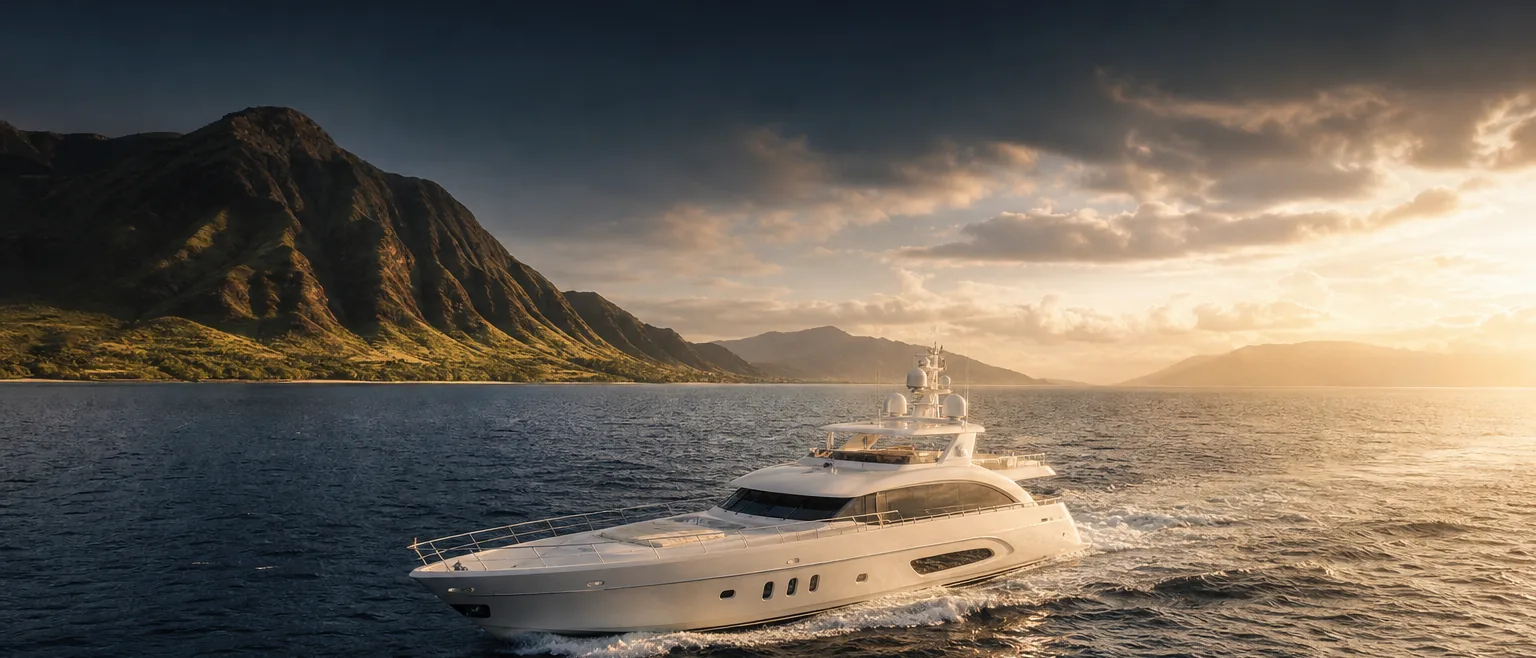
Honolulu to Maui — a common first interisland leg.
Planning context for the Oʻahu-to-Maui leg — often the first hop of a Hawaiʻi itinerary. Transit time is a planning estimate only and depends on the vessel, route, weather, and sea state; the captain owns the passage.
A frequent, practical opening leg for a Hawaiʻi voyage.
Honolulu to Maui is one of the most common interisland legs — leaving Oʻahu after clearance and initial provisioning, and arriving on Maui to continue the itinerary. HYANS coordinates the departure call at Honolulu and the arrival call on Maui, so fuel, provisioning, crew, and vendors line up at each end.
The shore-side plan matters as much as the passage. Deciding where to clear and fuel on Oʻahu, and which Maui berth or anchorage suits the vessel, shapes how the leg is staged. We confirm current status at each end before arrival rather than assume availability.
Common reasons for the leg
- →Starting an itinerary at Oʻahu and moving to Maui for the next phase
- →Positioning for charter guests or owner arrivals on Maui
- →Reaching an operating Maui harbor for provisioning, crew, or vendor work
- →Staging before continuing toward Hawaiʻi Island or Lānaʻi
Services to coordinate at the departure end
Each links to the full service page.
Port Coordination
Berth, clearance, and harbor coordination at the Honolulu departure end.
Learn more →Fuel & Bunkering
Fuel staged before departure, subject to supplier and port conditions.
Learn more →Crew Services
Crew changes and transport timed to the departure window.
Learn more →Interisland Support
Coordinated support across the leg and the arrival call on Maui.
Learn more →Weather & Routes
Supporting channel and forecast information for the captain to weigh.
Learn more →Provisioning & Concierge
Provisioning and logistics ahead of and after the crossing.
Learn more →Arriving on Maui — select an operating harbor or anchorage case by case.
On the Maui side, HYANS coordinates the arrival call at the harbor or anchorage confirmed for the vessel. Kahului is the commercial harbor and Māʻalaea is a small-boat harbor. Lāhainā Small Boat Harbor remains in recovery with only limited authorized commercial ocean operations; do not assume general access.
Small-boat harbor and anchorage space on Maui is limited and demand-driven. We confirm current availability and propose alternatives rather than assume a berth. Confirm current berth availability, draft limitations, operating status, and authority requirements before arrival.
Kaʻiwi and Pailolo channel context for the captain.
The Oʻahu-to-Maui leg typically involves the Kaʻiwi Channel off Oʻahu and, depending on the route, the Pailolo Channel between Molokaʻi and Maui. Both can build steep, wind-driven seas when the trades are strong, and conditions change quickly. HYANS can provide supporting forecast and channel context for your captain to weigh.
This is planning information, not a routing decision. The captain and operator choose the route and the window based on the vessel, current forecasts, and current authority guidance. Confirm channel and port status before arrival; the captain retains full navigation responsibility.
What to line up for this leg
Departure end (Honolulu)
- Clearance status and documentation, if arriving from abroad first
- Fuel uplift target and timing
- Provisioning for the leg and the next island
- Crew joining or departing at Oʻahu
Arrival end (Maui)
- Intended harbor or anchorage and draft
- ETA window (planning estimate)
- Vendor or technical work needed on Maui
- Onward plan after Maui
Frequently asked
How long is the Honolulu-to-Maui passage?
Which Maui harbor should we arrive at?
Can HYANS coordinate both the Honolulu departure and the Maui arrival?
Transit times are planning estimates only. Actual passage time depends on vessel type and speed, the route chosen, weather, sea state, traffic, and operational requirements. Confirm current channel and port status before arrival; the captain retains full navigation responsibility.
Planning the Honolulu-to-Maui leg?
Share your rough dates, the vessel, and your intended Maui harbor. HYANS will coordinate both ends of the leg and stage fuel, crew, and provisioning.