
Approval-gated
Guest logins are evaluation access only and are approved manually by platform staff — never self-service.
Trust & data
MERIDIAN is built for high-value, privacy-sensitive vessel operations. Access is approval-gated, invites are scoped, and the operating file stays with the vessel or operator that owns it.
How we handle access
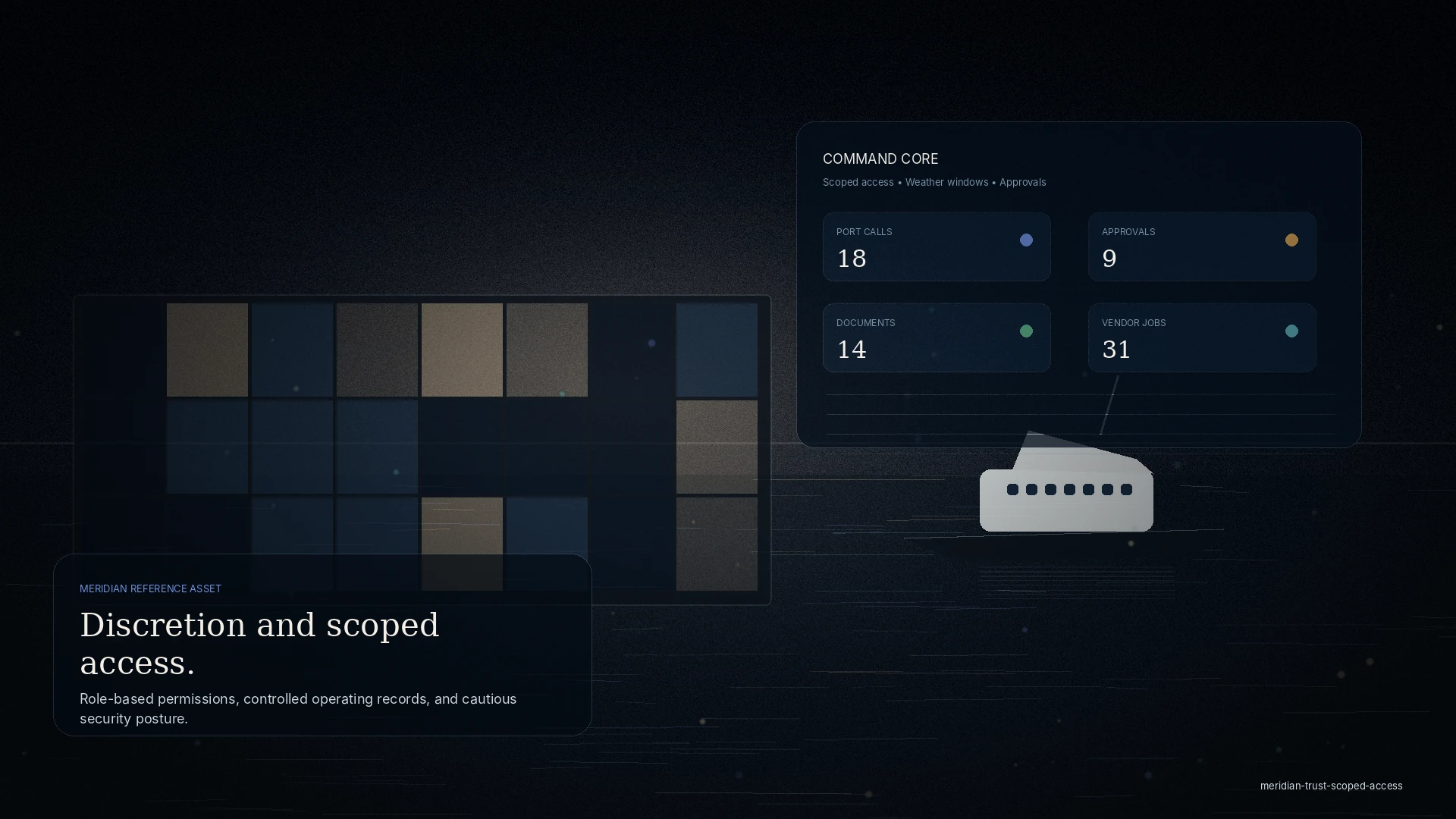
Every login is reviewed. Every invite is scoped. Sensitive principal, itinerary, and finance context is never exposed to a local partner who does not need it.
Guest logins are evaluation access only and are approved manually by platform staff — never self-service.
Local agents and vendors see only the visit, request, invoice, document, or task thread they were invited to.
The vessel or operator keeps the operating history after a port call closes. Invited partners contribute; they do not take the record with them.
Production workspaces launch with role-based permissions so each seat sees exactly what its job requires.
Security & compliance posture
MERIDIAN uses launch-target trust language. These are the controls we build toward and map to — not claims of completed certification. Current status is confirmed in the proposal and security review for your program.
A SOC 2 readiness roadmap covering security, availability, and confidentiality controls.
ISMS-aligned controls and documentation as the information-security baseline.
Privacy control mapping for personal data handling, access, and retention.
A processor-backed payment posture — card data is handled by the payment processor, not stored by MERIDIAN.
Document workflows aligned to maritime security and safety document expectations.
Authorized-signer checks and a sanctions-screening path as part of onboarding workflow.
These are target and readiness statements for planning. MERIDIAN does not claim completed certification or official approval until independently verified; the exact status and scope are confirmed in writing for your program.
Operational boundaries
Clear boundaries are part of the trust model. MERIDIAN coordinates work; it does not overstate what it decides or replace the people accountable for it.
Weather windows and anchorage context are planning-grade decision support, recorded with the call. They never replace the captain’s judgment — the decision stays with the vessel.
MERIDIAN is an operating layer for coordination — arrivals, service, documents, approvals, and notices — not a public booking or reservation widget.
Tenant and vendor portals are respectful and permissioned. Partners see the thread they were invited to — not a surveillance view of anyone’s activity.
MERIDIAN produces clean cost backup and exports; it does not need to replace your accounting system or an onboard planned-maintenance system.
Stated plainly
We use target, readiness, and mapped-control language until a credential is independently verified. When a certification is completed, we replace the roadmap language with the exact approved mark, scope, and date — not before.
Questions
Not yet. MERIDIAN builds toward SOC 2 Type I and ISO/IEC 27001 readiness and maps its controls accordingly. We state readiness and target status plainly and confirm the exact status in your program’s security review — we do not claim completed certification until it is independently verified.
Your own roles, and only the partners you invite — each scoped to the visit, request, document, or task you share. Sensitive principal, itinerary, and finance context is not exposed to local agents or vendors unless you share it.
No. It is planning-grade context recorded with the call. The captain owns the go or hold decision.
The operating file stays with the vessel or operator that owns it. Invited partners contribute to it; they do not take the record with them when their access ends.
Through a payment processor — card data is handled by the processor, not stored by MERIDIAN.
How access works
The order is deliberate: you review the model, complete intake, then request a guest workspace that platform staff approve manually.
Vessel Desk, Agency Desk, Management Fleet, or Destination Network.
Provide vessel, agency, fleet, property, or network context and expected scale.
Guest access is never self-service. Approved requests receive a scoped evaluation workspace.
Pricing, onboarding, modules, support, and data requirements are confirmed in writing.
Production workspaces launch with role-based permissions, templates, training, and support.
Infrastructure
MERIDIAN runs on Google Cloud Run in the us-west1 region. Traffic is served
over TLS with certificates issued by Google Trust Services, and HTTP Strict
Transport Security is enforced. Every one of those statements can be checked from outside:
the certificate issuer in your browser, and the Strict-Transport-Security header
on any response.
Google Cloud holds independent certifications for its own infrastructure. Those certifications cover Google's infrastructure, not this application. Under the shared responsibility model, everything above the platform — access control, tenant isolation, data handling and retention — is HYANS's responsibility and sits outside the scope of Google's audits. Running on certified infrastructure is not the same as being certified, and we do not claim to be.
Where a formal attestation is required for your own compliance programme, ask — we would rather tell you what we hold and what we do not than let a badge answer for us.
Ready
Guest workspaces are evaluation access only and are approved manually by platform staff.