
Less phone-tag
Tenants can request, track, and confirm work without repeated desk calls.
Coverage model
Coverage is presented as practical service reach: who can request, who fulfills, which locations are active, and what outputs are available to marina tenants.
Hawaii-ready operations
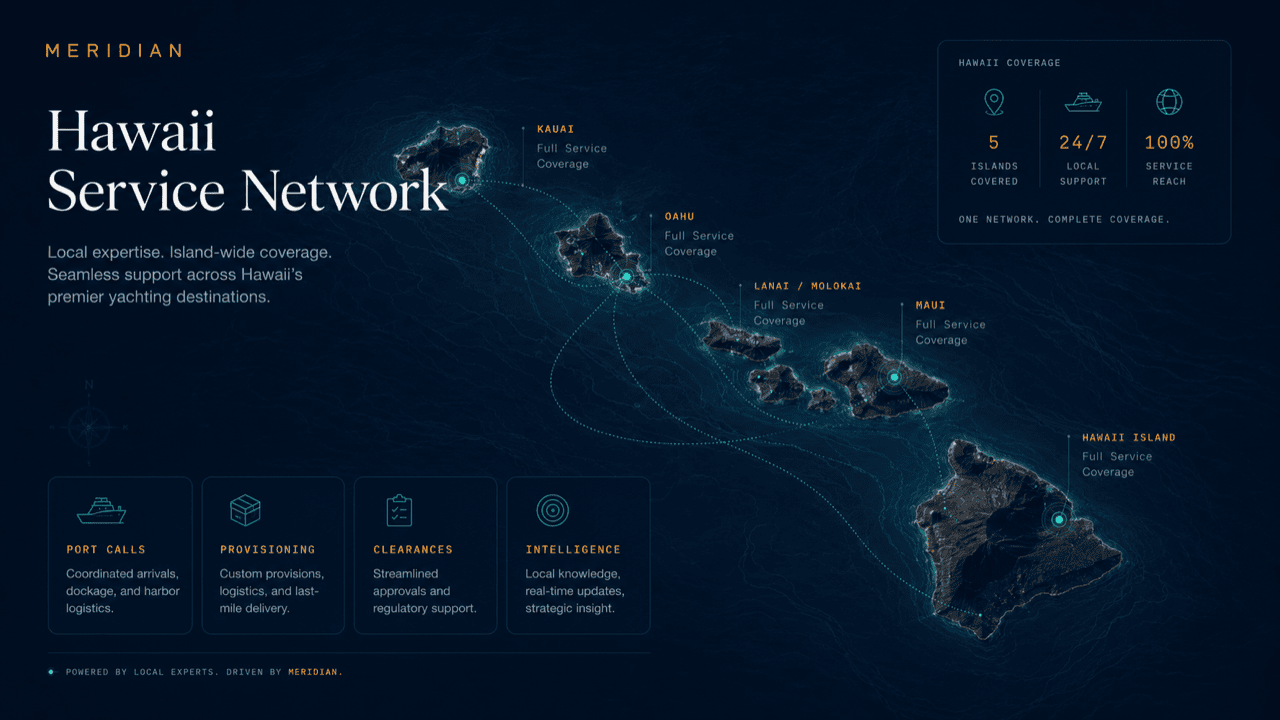
MERIDIAN coordinates service across Hawaii’s harbors, marinas, anchorages, and vessel programs — adapted to how your operation actually works.
Deployment layers
These cards can become future market modules, service-area pages, or CRM routing rules.
Tenants can request, track, and confirm work without repeated desk calls.
The right team receives enough detail at submission.
Tenants see whether the item is queued, scheduled, in progress, or complete.
Recurring issues and service records are easier to reference.
What coverage means here
For a tenant, coverage comes down to three practical things: your marina’s team can receive and fulfill your requests, your vessel profile and documents are ready wherever the relationship extends, and the notices that reach you are the ones that apply to your slip, dock, or vessel — not the whole property’s traffic.
Worked example
A generic cruising example: a tenant vessel leaves its home slip for several weeks, calls at other harbors, and returns.
You note the departure and expected return in your workspace. Slip status, contact preferences, and current documents sit in one place for the office — no “we’ll be gone a while” voicemail.
At a harbor that also coordinates through MERIDIAN, the same vessel profile and documents can be shared by invitation — arrival details stated once, not re-typed at every dock desk.
A service need comes up away from home. The request routes to the operating team covering that stop, while notices from your home marina continue to reach you unchanged.
You flag your return window. The office sees it alongside slip status and any dock notices, so your arrival is expected — not announced from the fairway.
The itinerary’s requests, documents, and notices form one continuous history. Nothing to reconstruct, nothing stranded in a text thread at another harbor.
Profile routing
Because the profile is persisted, return visits continue to this role-specific structure until the visitor switches profile.
Coverage questions
Straight answers about who fulfills requests, what happens away from home, and where coverage ends.
No. Your marina, harbor operator, and the vendors they clear fulfill the work. MERIDIAN is the coordination layer that carries the request, the context, and the status between you and them.
Your workspace, documents, and history stay intact, and your home marina’s notices keep reaching you. Where another location also coordinates through MERIDIAN, your profile can be shared with it by invitation.
No. Nothing is shared automatically. Sharing is by invitation, scoped to what the stop actually needs, and it remains permissioned the same way your home workspace is.
The relationship starts with your marina, but the model — permissioned profiles, location-aware intake, routed fulfillment — is built to extend across the harbors, marinas, and anchorages an operation serves.
You and the representatives you or your marina invite into your scoped workspace — and nobody else.
With the tenancy. Access is tied to the relationship with your marina, and scoped access ends when that relationship does.
Get started
If your marina runs MERIDIAN, ask them to invite you — tenant workspaces are private, permissioned, and invitation-based. Or reach out and we will point you to the right operating team.