
Fewer scattered channels
The captain-facing version organizes calls, messages, and service tasks into one queue.
Coverage model
Coverage is presented as practical service reach: who can request, who fulfills, which locations are active, and what outputs are available to captains & operators.
Hawaii-ready operations
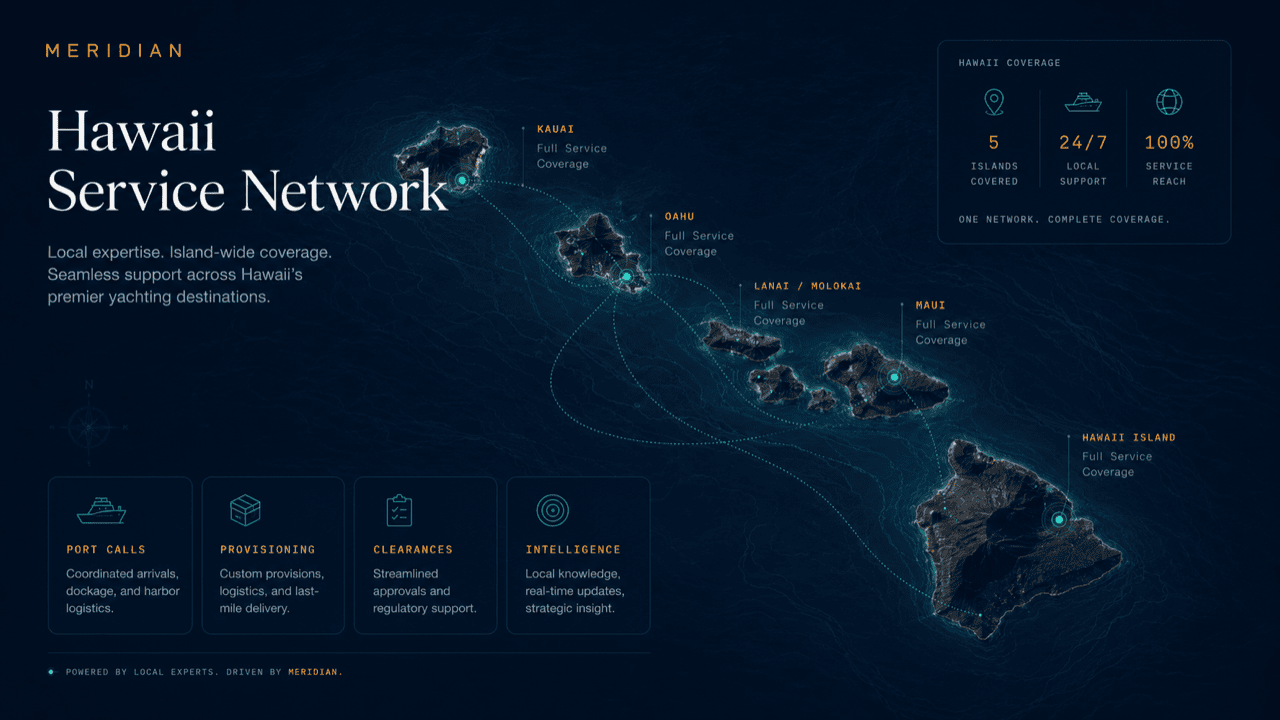
MERIDIAN coordinates service across Hawaii’s harbors, marinas, anchorages, and vessel programs — adapted to how your operation actually works.
Deployment layers
These cards can become future market modules, service-area pages, or CRM routing rules.
The captain-facing version organizes calls, messages, and service tasks into one queue.
Berth, vendors, documents, weather, and supplies are aligned before arrival.
Crew logistics become visible, timed, and accountable.
Departure tasks and missing items are obvious before the window closes.
A map of ports tells you where a company has been. What matters at 07:00 on arrival day is narrower: who can act for this vessel, here, today — and what they are allowed to see while they do it.
MERIDIAN treats coverage as scoped capability at each stop, carried by the vessel’s own operating file.
What coverage means here
Some stops are full-service ports with an agent and a deep vendor bench. Some are an anchorage and a provisions run. The operating file — profile, documents, preferences, history — is the constant; who fulfills each request changes port by port, and managers and principals read the same readiness picture at every stop.
Example: a multi-stop itinerary
A generic three-stop leg shows how the same desk flexes as the shoreside picture changes.
You invite the local agent and vendors into the call file. The vessel profile does the briefing; service history for the leg starts here.
Underway, the next call is already in preparation: berth request out, document asks answered from the file, services pre-staged against your ETA.
An anchorage and a short list: tender fuel and a provisions run. Same desk, smaller footprint — you invite only what the stop needs.
The marina sees arrival essentials, not the whole vessel. Documents are already on file rather than re-emailed to a new inbox.
Every request, completion, and note is consolidated on the vessel — one continuous history instead of fragments left behind in each port.
Profile routing
Because the profile is persisted, return visits continue to this role-specific structure until the visitor switches profile.
Questions
No. The desk travels with the vessel. At each stop, fulfillment adapts — an agency network, vendors you invite yourself, or a self-managed call where you simply keep the file.
The vessel’s operating file: profile, documents, preferences, contacts, and service history. That is the point of the model — the next port starts briefed.
Log what is worth keeping and move on. The call file is yours; even a bare entry keeps the vessel’s history continuous.
Yes — dispatchers and vessel operators can run multiple vessels’ calls from one seat, with each vessel’s file scoped to its own team.
Hawaii’s harbors and marinas are the current operating focus. The coverage model itself — profiles, scoped invitations, call files — applies wherever the itinerary goes.
Get started
See how the coverage model maps onto your itinerary and your vendor relationships, or request a walkthrough tailored to your operation. Access is reviewed and routed — guest workspaces are approved manually.