
Clearer scopes
Vendors get better job information before arriving.
Coverage model
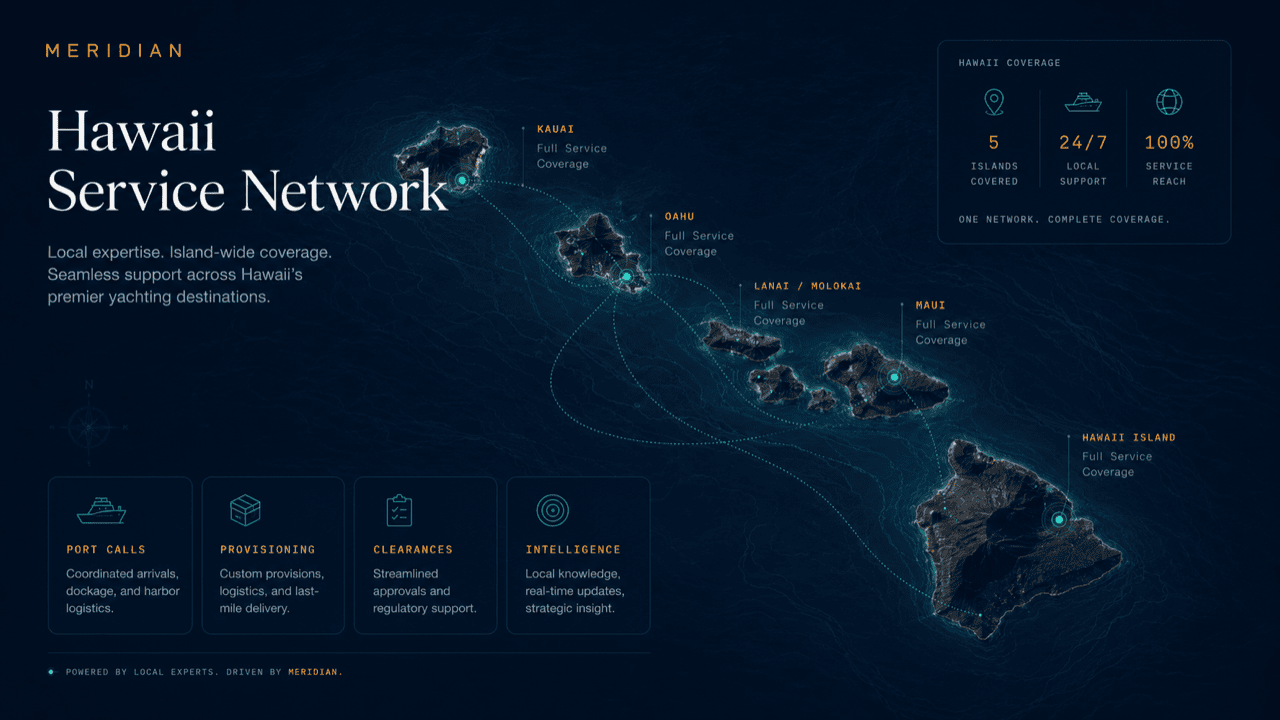
Coverage is presented as practical service reach: who can request, who fulfills, which locations are active, and what outputs are available to service vendors.
Hawaii-ready operations
MERIDIAN coordinates service across Hawaii’s harbors, marinas, anchorages, and vessel programs — adapted to how your operation actually works.
Deployment layers
These cards can become future market modules, service-area pages, or CRM routing rules.
Vendors get better job information before arriving.
Arrival instructions and contacts are attached to the work order.
Photos and notes are captured at the point of work.
The requestor sees what happened and what remains.
Coverage, from the vendor’s seat
For a vendor, coverage is not a map graphic. It is the practical question of which docks and operations can put work in your queue, what each site requires at the gate, and whether the job’s history follows the vessel when it moves beyond your home dock.
MERIDIAN treats each site as its own set of access rules — gates, escorts, delivery routes, contacts — attached to the work order, while the vessel’s operating file carries the service history from stop to stop. You work your sites; the record works the itinerary.
Your coverage grows operation by operation: each management agency, marina, or fleet that invites you adds its sites to where you can be dispatched. You see the stops where you hold a job — never the vessel’s wider movements.
Multi-stop example
A vessel program works through a multi-island itinerary; you are one of several vendors along the route.
Provisioning and an interior detail before departure. Your jobs carry that marina’s access rules, and your completion evidence lands on the vessel’s file.
The agency dispatches the next round to a vendor covering that harbor — or to your second location, if your company runs one. Same work-order pattern, different gate rules.
A dive hull check runs from a tender instead of a dock. Access coordination swaps gates for a rendezvous window and a crew contact; the evidence format stays the same.
The vessel returns with its record intact. Your next dispatch opens with the service history that touches your work already visible — because the file traveled, even though you didn’t.
Questions
No. You see the stops where you hold a dispatched job — the scope, the window, and that site’s access details. The wider movement plan stays with the vessel’s operation.
Yes. Multi-location operation is part of the upper vendor tier, with each location holding its own crews and access profiles — see the plans page.
That is a complete coverage model. Plenty of vendors serve one marina, and every operation that dispatches work to that dock can reach you there.
The current operating focus is Hawaii’s harbors, marinas, and anchorages. The coverage model itself — sites, access rules, and traveling vessel files — is not geography-locked.
Each site attaches its own requirements to the work order: a gate and escort at one marina, a delivery route at another, a tender rendezvous at an anchorage. Your crew always arrives with the current rules for that stop.
Profile routing
Because the profile is persisted, return visits continue to this role-specific structure until the visitor switches profile.
Get started
Join free when a subscribing operation invites you, or ask about multi-location vendor workspaces. Access is reviewed and routed — guest workspaces are approved manually.