
A stronger front desk
Tenant requests become trackable work instead of scattered calls and texts.
Coverage model
Coverage is presented as practical service reach: who can request, who fulfills, which locations are active, and what outputs are available to marina operators.
Hawaii-ready operations
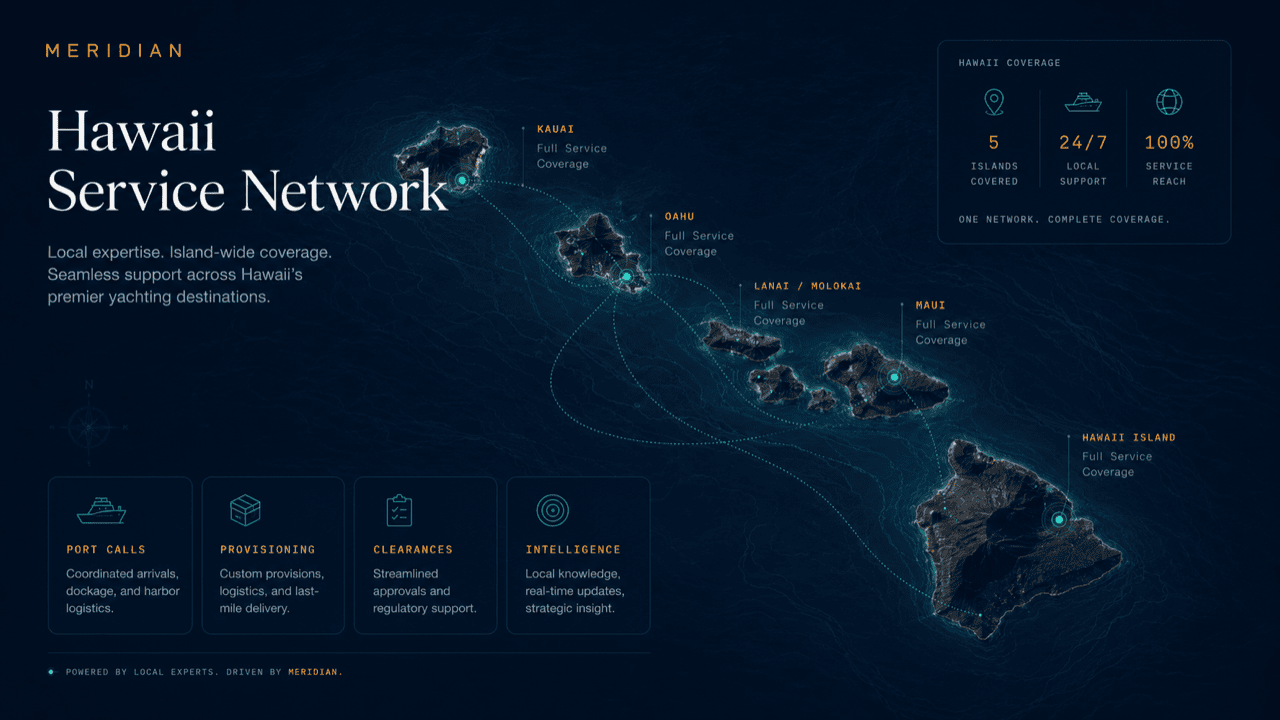
MERIDIAN coordinates service across Hawaii’s harbors, marinas, anchorages, and vessel programs — adapted to how your operation actually works.
Deployment layers
These cards can become future market modules, service-area pages, or CRM routing rules.
Tenant requests become trackable work instead of scattered calls and texts.
Slips, work orders, utilities, vendors, and notices are connected.
Tenants get visibility into status, timing, and completion.
The marina sees service load, response time, and recurring issues.
Coverage in practice
Marinas do not operate in isolation. The vessels at your docks arrive from somewhere and leave for somewhere — often run by a management agency, worked by captains and crews, and answerable to principals who expect the same service standard at every stop.
Coverage means your marina plugs into that movement without giving up its own boundaries. Requests can reach your desk before a vessel arrives. Your fulfillment record follows the visit instead of word of mouth. And what other operators, harbor masters, or vendors see of your operation is exactly nothing — each connected network profile is scoped to its own role at its own location.
Being reachable by the network is not the same as being visible to it. Your occupancy, tenants, and internal queues stay yours; only the service interface is shared.
Multi-property operators can roll up their own locations through Destination Network.
Worked example
A managed vessel plans a multi-harbor itinerary with a several-night stop at your marina in the middle. Here is what coverage means at each step.
The vessel’s management agency lines up the stops. Your marina receives a dockage request for its own window — vessel particulars, dates, and services needed — not the whole itinerary.
Before arrival, service requests for your stop land on your desk: berth fit, power requirement, a provisioning delivery window. You confirm what your property can fulfill.
During the stay, the visit runs like any resident operation — work orders, utilities, notices — inside your own ops view. The previous harbor’s stop is not your business, and yours is not the next one’s.
The vessel departs for its next stop. Your completion records — services delivered, meter close-outs, evidence — close at your property and stay in your file.
When the vessel calls again, your own history is on file: past berth, services used, notes your team recorded. Coverage compounds for you, at your property.
Questions
No — you see the request for your stop: the vessel particulars, dates, and services relevant to your property. The rest of the itinerary belongs to the vessel’s side of the operation.
No — occupancy, tenants, and internal queues are never shared. Other operators interact with your property only through the requests you accept.
Requests route by location and the service categories your property handles, so an inbound visit’s dockage and service needs land on your desk with time to plan.
No — a single marina participates fully. Operators with several locations can add rollups through Destination Network without merging their working boards.
The four primary operating seats — management agencies, principals & family offices, captains & crews, and commercial, passenger & charter fleets — plus the connected profiles around you: harbor masters, marina tenants, and service vendors.
Profile routing
Because the profile is persisted, return visits continue to this role-specific structure until the visitor switches profile.
Get started
See how coverage fits your marina, your tenants, and the traffic that moves through your region. Access is reviewed and routed — guest workspaces are approved manually.